What is GLP-1?
Inspiration
I’ve had this post as a task for well over a year now and I’m finally getting around to it
- With all of the buzz around GLP-1 agonists like Ozempic, I got to thinking how GLP-1 might relate to my own cravings or “addictions”. I wondered if it might be a signal to indicate how my behaviors affect my body function, sort of like understanding how my diet can affect my blood sugar.
My guess before digging in
- My guess is that GLP-1 is a receptor that agonists block or occupy preventing other expected molecules from attaching and being detected
Findings
- GLP-1 is a hormone, not a receptor
- The full name is glucagon-like peptide-1
- It’s produced naturally in your gut, specifically by a type of cell in the small intestine and colon called L-cells, and it’s released in response to eating, particularly after carbohydrates and fats hit your intestinal lining
- Once released, GLP-1 acts on GLP-1 receptors, which are found in several places throughout the body
- The hormone is the messenger, the receptor is the lock it fits into
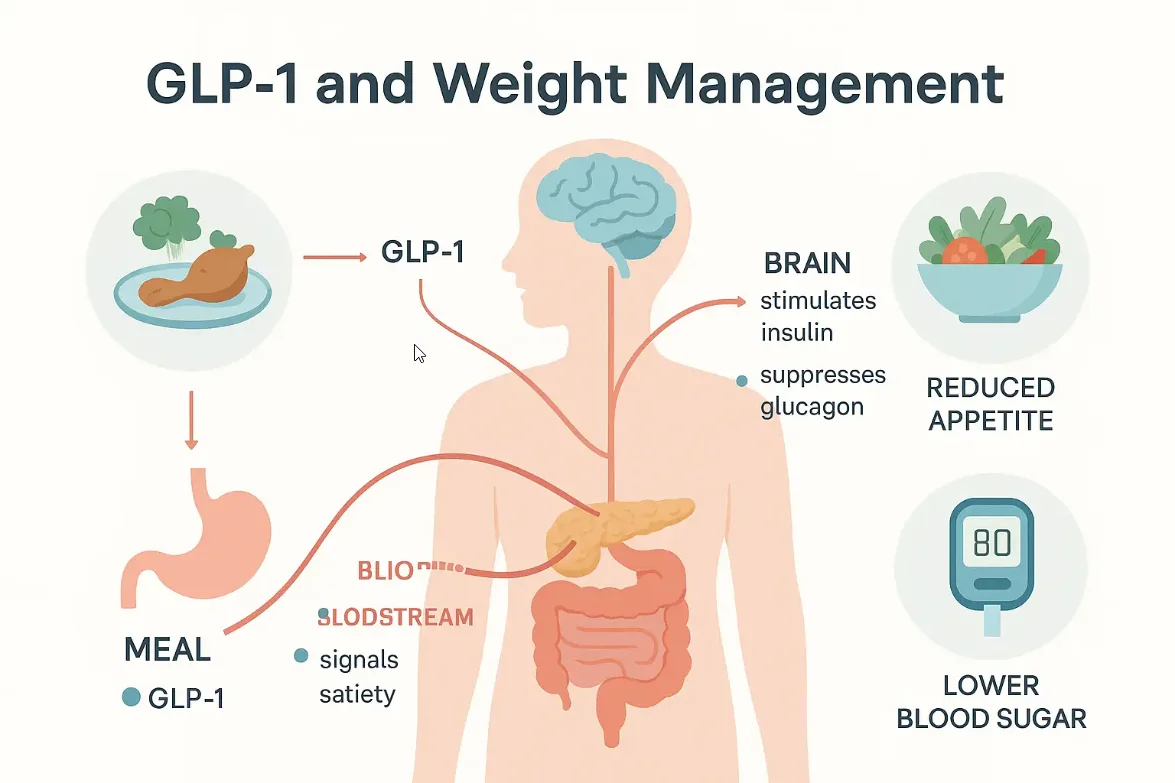
- The primary job of naturally produced GLP-1 is to coordinate your body’s response to a meal. It does this through several mechanisms:
- Stimulates insulin secretion, but only when blood glucose is elevated. This is called glucose-dependent insulin release, which is why it doesn’t cause runaway hypoglycemia on its own
- Suppresses glucagon
- Slows gastric emptying. Food moves out of your stomach more slowly, which smooths out the glucose spike after a meal and also contributes to feeling full
- Acts on the brain. GLP-1 receptors in the hypothalamus and brainstem reduce appetite and increase satiety
- Your body’s own GLP-1 is degraded extremely quickly, within about two minutes, by an enzyme called DPP-4 (dipeptidyl peptidase-4). So the natural hormone is real and functional, but it’s very short-lived. This is exactly why the medications had to be engineered. Drugs like semaglutide are modified to resist DPP-4 degradation and stick around for days instead of minutes, amplifying the signal far beyond what your body naturally produces
Etymology
- Glucagon
- Green roots
- “gluco-” from glykys, meaning sweet
- “-agon” from agein, meaning to lead, drive or bring forth
- So glucagon literally means something like “sugar driver” or “that which drives glucose”. It drives glucose out of the liver and into the bloodstream
- Green roots
Follow-up questions
What’s an agonist?
- A molecule that binds to a receptor and activates it. It mimics the effect of whatever naturally binds there. So a GLP-1 receptor agonist is a drug designed to bind to the same receptor that your natural GLP-1 hormone does, and trigger the same downstream effects. The difference is that the drug version is engineered to stick around much longer than the real thing
- The opposite is an antagonist. A molecule that binds to a receptor and blocks it without activating it, preventing the natural signal from getting through
- This makes me think of the effects of caffeine on our acetylcholine receptors when we drink coffee in the morning. The caffeine molecules are antagonistic on the acetylcholine receptors, blocking their signal from getting through, making us feel more alert
What is glucagon?
- It’s the hormone that tells your liver to dump glucose into the bloodstream. GLP-1 puts the brakes on that
What’s a peptide?
- A short chain of amino acids linked together. Amino acids are the building blocks of proteins and when you string them together you get:
- a peptide - short chain, roughly under 50 amino acids
- a polypeptide - medium
- a full protein - longer and usually folded into a complex 3D structure
- GLP-1 is 30 amino acids long, so it’s a small peptide. Many hormones are peptides. Insulin is too, which is why you can’t just swallow it as a pill. Your digestive system breaks down peptides into individual amino acids before they can be absorbed, destroying the signal in the process. That’s also historically why GLP-1 drugs had to be injected, though oral formulations now exist that use clever tricks to sneak the peptide past digestion
What are L-cells?
- A type of enteroendocrine cell, meaning they’re hormone-producing cells embedded in the lining of your gut, scattered among the regular absorptive cells. They’re most concentrated in the distal small intestine and colon, which is why GLP-1 release kicks in a bit after eating rather than instantly because food has to travel far enough to reach them
- L-cells also produce:
- GLP-2 - A sibling hormone that promotes intestinal lining repair and nutrient absorption rather than appetite regulation
- PYY (Peptide YY) - Another appetite-suppressing hormone. It slows gut motility and signals fullness to the brain, working alongside GLP-1
- Oxyntomodulin - A lesser-known hormone derived from the same precursor molecule as GLP-1 (a protein called proglucagon). It has both GLP-1-like and glucagon-like effects and also suppresses appetite
- What’s interesting is that L-cells are essentially multi-signal broadcasters. When food arrives, they don’t send one message, they send a whole coordinated suite of satiety signals at once
Can I use GLP-1 in my daily life?
- The actual lever is what you eat and how, because your L-cells respond to the contents of your intestines. You can’t feel GLP-1 as a discrete sensation, but you can set up conditions that make the system work better or worse for you
- A few things that are well-supported
- Soluble fiber (oats, legumes, vegetables) slows digestion and keeps food in contact with L-cells longer, which prolongs GLP-1 release. It also gets fermented by gut bacteria into short-chain fatty acids, which directly stimulate L-cells to produce more GLP-1. This is one concrete mechanism behind why high-fiber diets improve satiety and glucose control
- Eating protein-first or protein-heavy meals produces a more robust GLP-1 response than eating refined carbohydrates first. The practical implication is that eating vegetables and protein before the carbohydrate portion of a meal isn’t just glycemic index folklore, it genuinely affects the hormonal response
- GLP-1 release and satiety signaling take 15-20 minutes to ramp up. Eating quickly outruns the system. You’ve already consumed a lot before the brake kicks in. Slowing down isn’t just mindfulness advice, it’s letting your L-cells catch up
- This is an active research area, but there’s growing evidence that highly engineered foods, designed to be hyperpalatable and digest rapidly, don’t trigger L-cell signaling the way whole foods do, partly because they clear the stomach fast and partly because they’re low in fiber. The addictive quality of those foods isn’t just psychological, it may partly be that they’re engineered to bypass your natural satiety signaling
- Rather than thinking “I need to feel GLP-1,” think of it as a system you’re either feeding well or working around. Whole foods, fiber, protein and slower eating all tend to let the system do its job. Ultra-processed food, rapid eating and low-fiber meals tend to let you eat past the signal before it arrives
When did we discover GLP-1?
- In the 1960s, researchers first noticed a gap in their understanding when patients injected with glucose had smaller insulin response than patients who took oral glucose. This implied that the gut itself was sending a signal to the pancreas ahead of the glucose arriving. This was named the incretin effect, and they began hunting for the responsible hormone
- In 1982-83, researchers sequenced the proglucagon gene, which is the precursor protein that gets cleaved into different hormones depending on which tissue it’s in. In the pancreas it becomes glucagon. In the gut and brain it gets cut differently, yielding GLP-1 and GLP-2 among others
- An endocrinologist in 1992 discovered that the Gila monster’s venom contained a peptide (exendin-4) that mimicked GLP-1, but was resistant to DPP-4 degradation, the enzyme that destroys natural GLP-1 in minutes. Exendin-4 became exenatide (Byetta), approved in 2005, the first GLP-1 agonist drug. Semaglutide came much later, approved in 2017 for diabetes and 2021 for obesity
How are oral GLP-1 agonists formulated to avoid digestion?
- Peptides are exactly what your digestive system is designed to dismantle, and the stomach’s acidic environment plus proteolytic enzymes would destroy semaglutide before it could be absorbed
- The oral version of semaglutide (brand name Rybelsus) solves this with a co-ingredient called SNAC (sodium N-(8-[2-hydroxybenzoyl]amino)caprylate). SNAC is an absorption enhancer that does two things simultaneously:
- Locally raises the pH in the immediate microenvironment around the tablet as it dissolves in the stomach. This creates a small buffer zone that partially shields the semaglutide from acid degradation
- Transiently increases permeability of the stomach lining, allowing the semaglutide to be absorbed directly through the stomach wall, bypassing the small intestine entirely, where most peptide-destroying enzymes live
- You have to take Rybelsus on an empty stomach with a small amount of water, not a full glass, and wait 30 minutes before eating or taking other medications. This is because food, extra water, or other drugs all dilute or disrupt the local SNAC environment that makes the absorption work
- The bioavailability is still relatively low compared to injectable semaglutide, somewhere around 1% of the dose actually makes it into circulation, which is why oral doses are much higher (milligrams) than injectable doses (micrograms), but it works well enough to be clinically effective
What’s a proteolytic enzyme?
- An enzyme that breaks proteins (and peptides) apart by cutting the bonds between amino acids
- “Proteo-” refers to protein, “-lytic” means breaking down. So it’s protein-breaking
- The digestive system deploys several of these and they work in sequence. The stomach produces pepsin, which starts the demolition job in the acidic stomach environment. Then when the partially broken-down material moves into the small intestine, the pancreas releases a second wave: trypsin, chymotrypsin, elastase and others, that finish cleaving the fragments down into individual amino acids or very small peptides that can be absorbed through the intestinal wall
How can I stop mixing up glucose, glucagon, glycogen, glycerin, etc.?
- They all share the same Greek ancestor for sweet, glykys. The “gluc-” and “glyc-” spellings are just two transliteration paths from the same Greek root
| Word | Root | Suffix | What the suffix means | Net meaning |
|---|---|---|---|---|
| Glucose | glyk- | -ose | chemical suffix for a sugar | the sweet sugar itself |
| Glycogen | glyk- | -gen | from genein, to produce/create | the thing that generates glucose (stored form in liver/muscle) |
| Glucagon | glyk- | -agon | from agein, to drive/lead | the hormone that drives glucose into blood |
| Glycerin | glyk- | -erin | diminutive/substance suffix | a sweet-tasting oily compound (it genuinely tastes sweet) |
| GLP-1 | glyk- | — | “glucagon-like” | a peptide structurally similar to glucagon (same proglucagon precursor) |
A few anchors that might help them stick:
- -ose = sugar
- This one is worth memorizing as a general rule. Glucose, fructose, sucrose, lactose, galactose. The -ose ending is chemistry’s standard marker for a sugar. So whenever you see -ose, you’re looking at a sugar molecule itself
- glyco-gen = genesis of glucose
- Glycogen is your body’s glucose savings account, stored in the liver and muscles. The “-gen” is the same root as genesis, generate, gene. It generates glucose when you need it between meals.
- gluca-gon = gone glucose (into the blood)
- Glucagon is the hormone that tells the liver to release stored glycogen as glucose. It drives glucose out and up. You could think of the “-agon” as “agonizing” your blood sugar upward, or just remember it as the antagonist to insulin (insulin lowers blood sugar, glucagon raises it)
- Glycerin is the odd one out
- It’s not a sugar and not a hormone. It’s a simple compound with three carbon atoms and three -OH groups that happens to taste sweet, which is why it got the glyk- name historically. It shows up in soap, skincare, and as a food additive. You can basically file this one separately from the biological glucose family
- The GLP-1 name clicks into place once you know the others
- It’s a peptide that looks structurally like glucagon (they come from the same precursor protein, proglucagon), but functionally does roughly the opposite in many respects. It lowers blood sugar rather than raising it. The “like” in glucagon-like is about molecular ancestry, not behavior
Source: Claude (Sonnet 4.6) training data
Thanks for reading. If this was useful,
buying me a coffee
is the clearest signal I've got that it's worth writing more.
Questions or corrections are welcome at
jlmc.space@gmail.com