What's the difference between a mainframe and a server?
Inspiration
- This came up in conversation at a Meetup where someone used “mainframe” to describe a central computer that terminals connect to, which raised the question of how that differs from what we’d call a “server” today.
My guess before digging in
- I remember looking this up years ago and it had something to do with transaction-processing speed and the purpose-built, single-task nature of mainframes. I believe they do one thing extremely well and reliably. I recall airports and credit card companies as primary modern users
Findings
Source: What Is a Mainframe? | IBM (opens in a new tab)
Mainframes
- Purpose-built for massive, high-volume transaction processing (OLTP) and batch jobs where reliability and data integrity are non-negotiable, like a bank crunching several billion transactions per day. They’re designed for organizations running critical tasks that demand high processing power, reliability and security, and engineered for consistent, reliable performance even at high utilization over long stretches of time
- They run on IBM’s own hardware lineage (IBM z Systems dominate over 90% of the mainframe market) with their own OS (z/OS) and legacy languages like COBOL, while commodity servers run on x86/ARM with Linux or Windows. You can’t migrate workloads between the two without a full rewrite
- A single mainframe is a large, self-contained, highly redundant unit with centralized data storage and resource administration. Every component (power, cooling, CPUs, I/O) has multiple layers of backup baked in
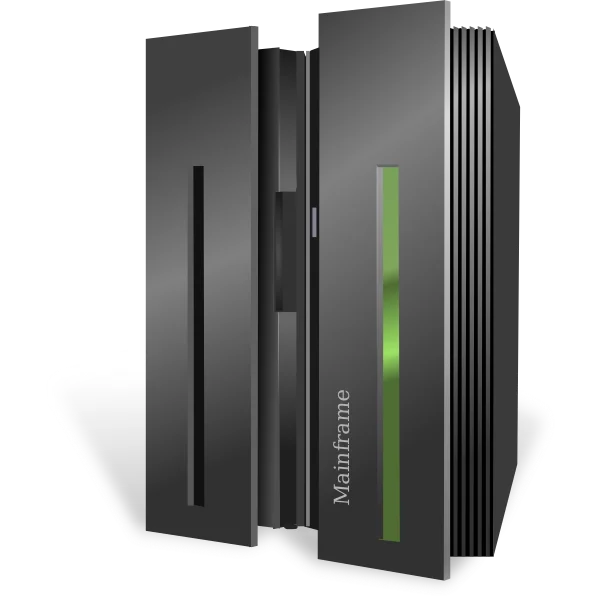
- IBM itself describes the mainframe as simply the largest type of server in use today
Servers
- Optimized for delivering services to clients, like file hosting, web apps, DNS, VPNs, rather than raw transaction crunching, and they typically scale by spreading work across multiple machines rather than one giant one
- Server farms get reliability through quantity (cheap, swappable, clustered x86 boxes) rather than building one bulletproof machine
Etymology
- The term traces back to the IBM 701 in 1952, where the machines was physically divided into multiple cabinets called “frame”: a power frame, storage frame, tape frame. The cabinet holding the core processing circuitry was called the “main frame.”
Follow-up questions
What’s OLTP?
- Online Transaction Processing. It’s the category of computing workload built around handling lots of small, discrete transactions in real time. Think “update one row, commit it, move to the next one” rather than crunching through a huge dataset all at once. Examples would be a single ATM withdrawal, one credit card swipe, one airline seat booking, or one bank balance update. It has strict consistency requirements and usually is described in terms of ACID properties
What are ACID properties?
- Atomicity, Consistency, Isolation and Durability, which is the formal way a database talks about “this transaction either fully happens or doesn’t happen at all.”
Any signs that servers will usurp mainframes?
Source: Equinix (opens in a new tab)
- People have been making this prediction for over 30 years and the current data actually points the other direction
- Many banks are actually bringing more applications onto their IBM X mainframes, partly because a single IBM x17 can replace up to 2,944 x86 cores while cutting power use by up to 83% compared to x86 for AI-enhanced OLTP workloads
- The typical approach to moderinizing around mainframes is to wrap the existing COBOL logic in APIs so modern apps can talk to it, rather than rewriting the core transaction engine itself
Thanks for reading. If this was useful,
buying me a coffee
is the clearest signal I've got that it's worth writing more.
Questions or corrections are welcome at
jlmc.space@gmail.com