Synthesizing Obsidian periodic notes with Claude Code
Overview
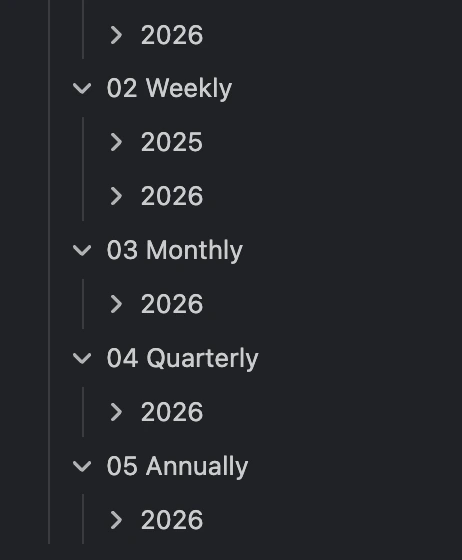
I keep a daily note in Obsidian, but I’d never reliably sit down and roll those daily notes up into a weekly summary, let alone a monthly, quarterly, or annual one — it’s the kind of synthesis that’s valuable in hindsight and easy to skip in the moment. periodic_notes (opens in a new tab) uses Claude Code to write that rollup for me, built from the notes one level below it: a week from its 7 daily notes, a month from the weekly notes whose Monday falls within it, a quarter from its 3 monthly notes, a year from its 4 quarterly notes.
What it does
Two scripts split the work: generate_periodic_notes.py gathers the child notes for a given period and handles the date math, and synthesize_periodic_note.py is the orchestrator — it determines the target period, stages the source notes, invokes claude non-interactively to write the synthesis, then moves the finished note into the vault.
periodic                                  # last week (default)
periodic --type month 2026-06             # a specific month
periodic --type month 2026-06 --dry-run   # inspect before writing to the vault
With no date given, each --type defaults to the most recently completed period of that type.
Why it’s built this way
Claude never touches the live vault. Source notes are copied to a staging directory first; Claude is invoked with that staging directory as its working directory and a restricted tool list, so its filesystem access literally cannot reach the real vault. The only write against the vault is a single shutil.move of the finished note — one line in the whole pipeline that can do damage, and it’s gated behind a check that refuses to overwrite an existing file. --dry-run skips that move entirely, leaving the result in staging for review. When you’re handing an LLM write access to years of personal journal entries, the safety property you actually want isn’t “it’s usually careful” — it’s “it’s structurally unable to touch the thing you care about.”
No task-manager integration, on purpose. An earlier version called a TickTick MCP server to auto-populate the “Completed tasks” section. It was removed — not because it didn’t work, but because the actual workflow was pasting tasks in manually anyway, and the integration added a personal-service dependency for a problem that wasn’t really there.
No tags: field, on purpose. Claude wasn’t reliably adding it even when instructed to, so rather than have a flaky field, the script drops it entirely. Sometimes the right fix for an unreliable LLM behavior is to stop asking for it rather than to keep prompting harder.
A gotcha worth knowing
CLI date validation is strict on purpose: --type month requires zero-padded YYYY-MM (2026-06, not 2026-6). A prior version accepted the unpadded form, and that laxness once turned a “let me test some bad input” run into a real pipeline execution, because the “bad” input was silently valid. If you’re testing that a validator rejects something, actually confirm the rejection — don’t assume a shape looks malformed just because it looks unusual.
Try it yourself
You’ll need Python 3.10+, the Claude Code CLI (opens in a new tab) installed and authenticated, and an Obsidian vault using the Journals plugin (opens in a new tab) with a specific folder layout. Full setup, the vault layout, and an optional man periodic page are in the README (opens in a new tab).
codeberg.org/splitsubdued/periodic_notes (opens in a new tab)
Related
Thanks for reading. If this was useful,
buying me a coffee
is the clearest signal I've got that it's worth writing more.
Questions or corrections are welcome at
jlmc.space@gmail.com