What's the difference between taro and ube?
Inspiration
- I was chatting with a friend when he said he went to a bubble tea shop. I looked at the menu and they had ube and taro, so it made me think that they might not be the same thing
My guess before digging in
- “Ube” might be the Japanese name for taro.
Findings
Ube
Source: Wikipedia (opens in a new tab)
- The Latin name is dioscorea alata. It’s also called ube, ubi, uwhi, purple yam and greater yam
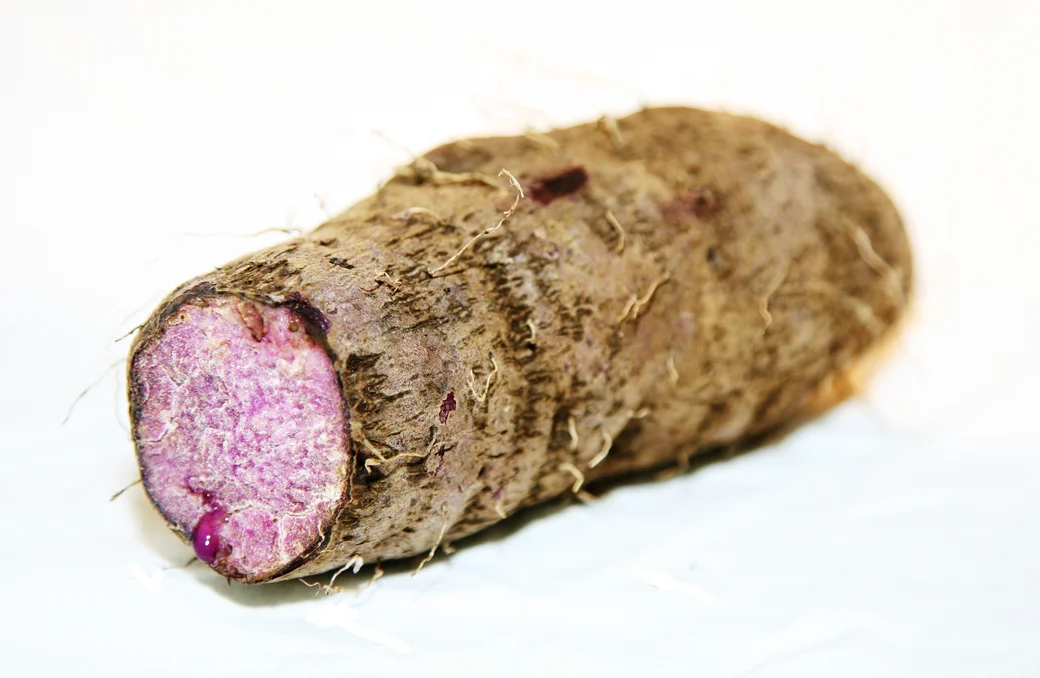
- It’s a species of yam (a tuber). The tubers are usually a vivid violet-purple to bright lavender (hence the common name)
- It’s sometimes confused with taro and the Okinawa sweet potato beniimo (紅芋). Ube is also grown in Okinawa
- The violet cultivars turn dishes distinctively vivid violet because of the high amount of anthocyanins
Taro
Source: Wikipedia (opens in a new tab)
- The Latin name is Colocasia esculenta
- It’s a perennial, tropical plant that has rhizomes of different shoes and sizes
- The edible root has a light purple color due to phenolic pigments, are roasted, baked or boiled. The natural sugars give a sweet, nutty flavor.
- In its raw form, the plant is toxic due to the presence of calcium oxalate, and the presence of needle-shaped raphides in the plant cells. However, the toxin can be minimized and the tuber rendered palatable by cooking, or by steeping in cold water overnight
Etymology
Ube
- ube is the Filipino word for purple
- The name ube is derived from Tagalog in the Philippines while uwhi derives from Māori in New Zealand; both are doublets ultimately from Proto-Austronesian qubi.
Taro
- The Ancient Greek word κολοκάσιον (kolokasion, lit. ’lotus root’) is the origin of the Modern Greek word kolokasi (κολοκάσι); the word for the plant is kolokas in Greek, gölevez in Turkish, and qulqas (قلقاس) in Arabic. These were borrowed by Latin as colocasia, thus becoming the genus name Colocasia. The specific epithet, esculenta, means “edible” in Latin
- The English name taro was borrowed from the Māori language when Captain Cook first observed Colocasia plantations in New Zealand in 1769. The form taro or talo is widespread among Polynesian languages: taro in Tahitian; talo in Samoan and Tongan; kalo in Hawaiian; taʻo in Marquesan. All these forms originate from Proto-Polynesian talo, which itself descended from Proto-Oceanic talos (cf. dalo in Fijian) and Proto-Austronesian tales (cf. taleus in Sundanese & tales in Javanese)
Follow-up questions
What is anthocyanin?
- Anthocyanins (from Ancient Greek ἄνθος (ánthos) ‘flower’ and κυάνεος/κυανοῦς (kuáneos/kuanoûs) ‘dark blue’), also called anthocyans, are water-soluble vacuolar pigments that, depending on their pH, may appear red, pink, purple, blue, or black. Food plants rich in anthocyanins include the blueberry, raspberry, black rice, black carrot and black soybean, among many others that are red, pink, blue, purple, or black. Some of the colors of autumn leaves are derived from anthocyanins
Do we get xanthum gum from the cousin of taro?
- No. Xantham gum gets its name from the species of bacteria used, Xanthomonas campestris whereas the cousin of taro that I read was Xanthosoma sagittifolium. The etymology of the prefix xantho- is of Greek origin, meaning “yellow” from the Greek xanthos
Thanks for reading. If this was useful,
buying me a coffee
is the clearest signal I've got that it's worth writing more.
Questions or corrections are welcome at
jlmc.space@gmail.com