What are the common types of cinnamon
Inspiration
- I’ve been making my own spiced drinks lately like masala chai and horchata. They both call for different types of cinnamon stick. I also read that the type of cinnamon most frequently used in [[United States|American]] cooking has a higher concentration of some compound that can be unhealthy for us if consumed regularly and in higher quantities
My guess before digging in
- There are probably hundreds of species of cinnamon, but only a handful are cultivated for culinary use. Some may be cultivars that evolved when brought to different regions by various spice trades
Findings
Source: Wikipedia
- Cinnamon is a spice obtained from the inner bark of several tree species from the genus Cinnamomum
- The characteristic aroma and flavor of cinnamon derive from its essential oil and principal component, cinnamaldehyde, as well as numerous other constituents, including eugenol
- Cinnamomum verum, for canela in Spanish, formerly Cinnamomum zeylanicum
- Known as [[Sri Lanka|Ceylon]] cinnamon, considered “true cinnamon”, but most cinnamon in international cuisine is derived from four other species, usually more correctly referred to as “cassia”
- Native to [[India]], [[Sri Lanka]], [[Bangladesh]] and [[Myanmar]]
- Ultra low courmarin levels that don’t damage the liver
- Cinnamomum burmannii
- [[Indonesia|Indonesian]] cinnamon, Padang cassia, or Korintje
- Cinnamomum cassia also Cinnamomum aromaticum
- Chinese cinnamon or Chinese cassia
- Native to [[Travel/Asia/China|China]]
- Comprised 39% of commercially sold cinnamon in 2023
- The most common commercial type in the [[United States|US]]
- High levels of coumarin that can damage the liver
- Cinnamomum loureiroi
- [[Ho Chi Minh City|Saigon]] cinnamon or [[Vietnam|Vietnamese]] cassia
- Cinnamomum citriodorum
- Less common
- Malabar cinnamon
- The plant is an evergreen tree characterized by oval-shaped leaves, thick bark and a berry fruit
- The leaves are also harvested
- In [[Japan]], the more pungent roots are harvested to produce nikki (ニッキ), which is a product distinct from cinnamon (シナモン shinamon) Source: King Arthur Baking
- There are hundreds of local, non-commercial cinnamon varieties used for various purposes — baking, cooking, and medicine — all across the globe
Etymology
- Cinnamon derices from the Ancient Greek via Latin and medieval French intermediate forms. The Greek κιννάμωμον (kinnámōmon, later κίνναμον: kínnamon) was borrowed from a Phoenician word, which was similar to the related Hebrew word קנמון (qinnāmōn)
- The name “cassia”, first recorded in late Old English from Latin, ultimately derives from the Hebrew word קציעה qetsīʿāh, a form of the verb קצע qātsaʿ, “to strip off bark”.
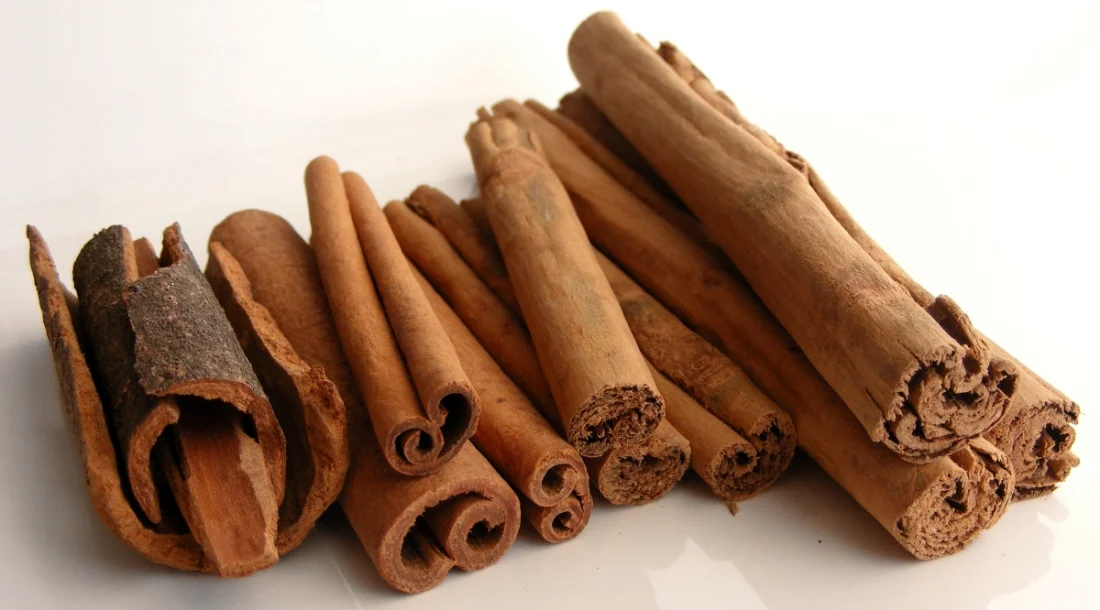
- Early Modern English also used the names canel and canella, similar to the current names of cinnamon in several other European languages, which are derived from the Latin word cannella, a diminutive of canna, “tube”, from the way the bark curls up as it dries
Follow-up questions
Where is Malabar
- It’s an administrative district on the southwestern Malabar Coast in Madras State in [[India]]. Madras state no longer exists. The Malabar Coast is now part of [[Kerala]]
Can you eat cinnamon tree berries?
Source: Cinnamon Tree Berries Information and Facts
- Cinnamon buds have a clove-like appearance. They have a short stem attached to a round bud which consts of the flower remnants curled around the immature and not fully developed fruit of the cinnamon tree
- Cinnamon buds are also known as Cassia buds. They’re dried budding seeds of the cinnamon tree
- There are two different varieties of cinnamon tree that produce both the buds as well as the bark
- Cinnamomum verum and Cinnamomum cassia
- They are used whole or ground, like black peppercorns
What’s the type of cinnamon I grew up with in the US?
- Any of the three that aren’t Ceylon cinnamon because they’re significantly cheaper to produce and import
- Korintje and Saigon, specifically in that order, are the two most frequently sold in ground cinnamon bottles at big-box stores. When you flip over to check out the ingredient list on a bottle and see “ground cinnamon," you can assume it’s one of these two
Thanks for reading. Questions or corrections are welcome at
jlmc.space@gmail.com. If this was helpful and you'd like to support the site, a coffee is always appreciated.